
The Knowing-to-Doing Pathway™
An organising principle for designing leadership development that changes behaviour.
Organisations invest in leadership development because they want something to change.
They want leaders to make better decisions, have better conversations, and create better outcomes for the people they lead and the organisations they serve.
Yet despite significant investment in leadership assessments, coaching and programs, many organisations continue to wrestle with the same challenge:
Why doesn't what leaders learn always translate into what leaders do?
This is the knowing-doing gap.
The space between understanding something intellectually and consistently applying it in practice.
It's a challenge that anyone who has ever designed leadership development recognises:
A leader attends a program. They gain new insights, learn useful tools and leave motivated to do things differently.
And then they return to work.
Competing priorities appear, old habits resurface, and their good intentions get crowded out by the demands of everyday leadership.
The issue usually isn't that the learning wasn't valuable. It's that learning was only ever part of the journey.
Learning isn't the destination.
Leadership development is often described in terms of learning.
We create learning objectives. We design learning experiences. We measure learning outcomes. There is nothing wrong with this – learning matters. But it’s still worth asking:
What are organisations really hoping will be different after investing in leadership development?
Rarely is the answer: "Our leaders will know more." More often, it sounds something like:
Our leaders will navigate change with confidence.
They will create clarity from complexity.
They will empower the people around them.
In other words, the desired outcome isn't usually knowledge. It's different leadership behaviour. This distinction matters because learning and behaviour change are related but not the same thing. Learning creates the possibility of change.
It doesn’t guarantee it.
Why the knowing-doing gap persists.
I have come to believe that the knowing-doing gap persists partly because we have become very good at designing leadership development for learning.
The problem is that learning is not always the outcome we are ultimately trying to achieve – behaviour change is.
I don’t think this is necessarily surprising. Learning is easier to design around.
We can define content, build workshops, structure activities, create resources and measure how satisfied participants are with the experience.
Behaviour change is harder. It unfolds over time, requiring people to experiment, practise, receive feedback, adapt and continue applying new behaviours even when the environment around them seems to tug them back to their previous way of doing things.
So, we design leadership programs around the moment of learning, often leaving application and reinforcement to happen afterwards. But what if we incorporate behaviour change into the design of leadership development itself?
When practice meets research.
For more than 25 years, I have designed leadership development across different industries, organisations, and leadership levels.
With each program providing an opportunity to learn, test, and refine, I noticed that certain design choices seemed to make behaviour change more likely:
Creating awareness before introducing new concepts.
Building motivation before expecting action.
Allowing space to practise before applying new behaviours in complex environments.
Supporting reflection after implementation.
In isolation, these ideas were not new. Most were well supported by research on program effectiveness, learning transfer and behaviour change. What caught my attention was the emerging consistency in the sequence of design steps that seemed to best support leaders in moving from understanding something new to changing the way they led.
The connection became clear when I recognised that the pattern I was seeing in practice reflected a behaviour change model I had first encountered much earlier in my career as a Psychology Honours student, supporting call centre employees to increase their incidental physical activity at work: the Transtheoretical Model of Behaviour Change.
The enduring appeal of the Stages of Change.
The Transtheoretical Model, developed by psychologists James Prochaska and Carlo DiClemente, is one of the most widely recognised models of behaviour change. Many people know it simply as the Stages of Change model:
Precontemplation – you do not see a problem or need to change yet.
Contemplation – you start thinking about making a change and what it might take.
Preparation – you plan to act soon, taking small steps toward change.
Action – you actively make the change and start using new behaviours.
Maintenance – you work to keep the change going and avoid falling back into old habits.
The model suggests that people don't simply change because they receive new information. They move through a process in which they first become aware of the need or opportunity to change, consider whether change matters, begin preparing to change, act on the need to change, and then work to sustain new behaviours over time.
It's not hard to see why the model became popular, as it captures something that feels intuitively true. Anyone who has tried to change a behaviour, whether personally or professionally, knows that information alone rarely creates lasting change.
Knowing what to do and consistently doing it are very different things.
At the same time, the Stages of Change model has attracted significant criticism since its introduction in the early 1980s, with Robert West, Professor of Psychology at UCL, flatly stating that it should be abandoned altogether.
Researchers have questioned whether people really move through distinct stages, given that behaviour change is rarely neat or linear. People progress, regress, restart and adapt. In this sense, real change is far messier than any model can capture.
I think these criticisms are important, and I know from experience that leadership behaviour doesn't change in a predictable sequence.
However, I think there is another way to think about the model, and I think Stephen Sutton, Professor of Behavioural Science at the University of Cambridge, puts this best: what if the greatest value of the Stages of Change model is not as a perfect description of how people naturally change, but as a guide for designing interventions that support change?
That distinction – from a descriptive to a prescriptive model - matters. It recasts the five stages from explaining the typical way people change to outlining useful steps people can follow to change their behaviour, which, in turn, can inform the design of more effective approaches to help people change.
And given that sustained changes in leadership behaviour are what enable leadership programs to create value, I believe the Stages of Change model may yet add value to the question I’m most interested in answering:
How can we design leadership development experiences that make behaviour change more likely?
That’s when research and practice converged for me. The pattern I had been seeing through years of designing leadership programs had a foundation in decades of thinking about how people change.
The Knowing-to-Doing Pathway™
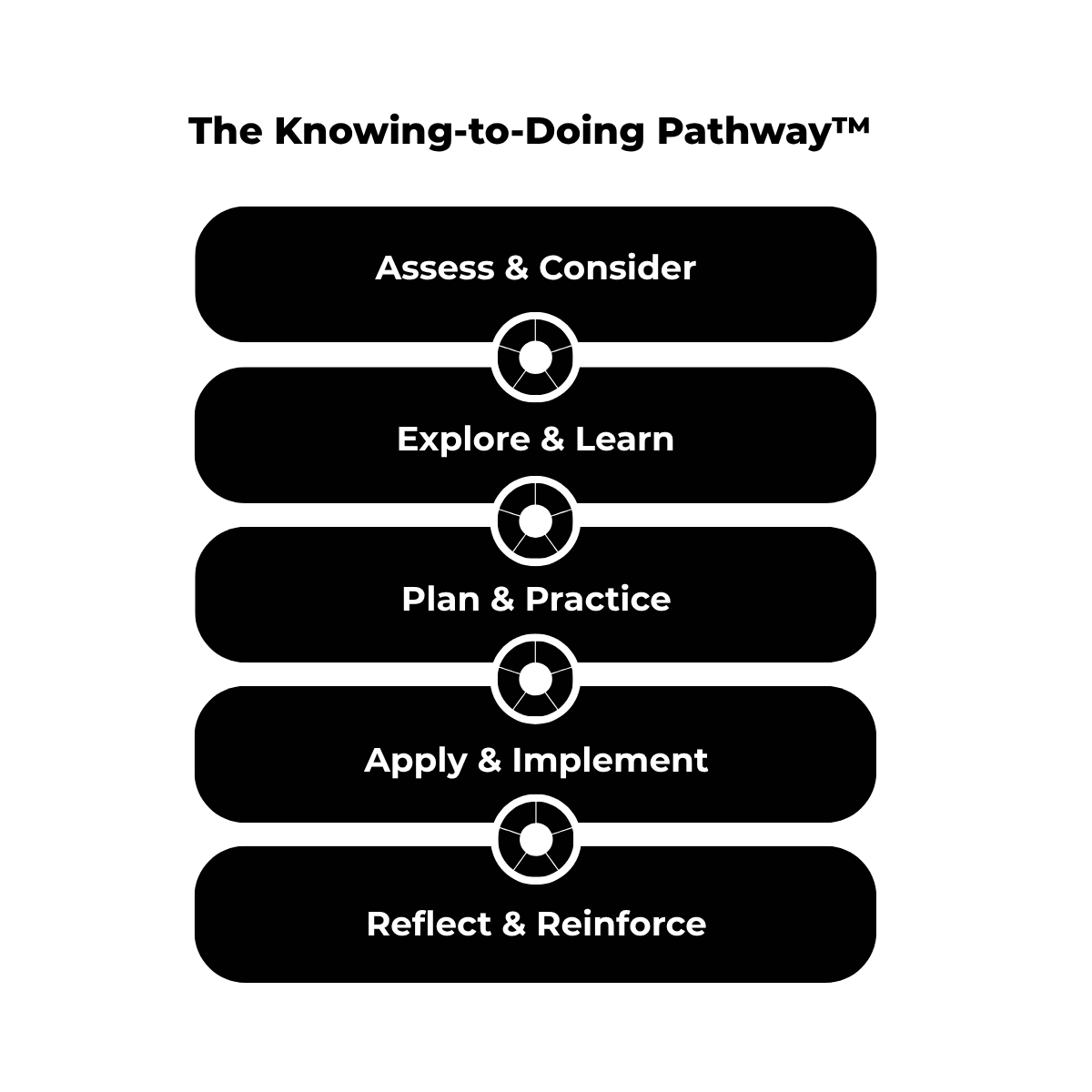
The Knowing-to-Doing Pathway™ is the organising principle I developed to design leadership development in line with how behaviour change is most likely to occur.
It brings together research and practice with five steps to support leaders in moving from insight to action and from action to sustained behaviour:
Assess & Consider – Raise awareness of the impact of current leadership behaviour and build motivation for change.
Explore & Learn – Explore different ways of leading and learn new approaches.
Plan & Practice – Prepare, experiment with, and practise new behaviours.
Apply & Implement – Apply new leadership behaviours in real work situations.
Reflect & Reinforce – Embed behaviour change through feedback, reflection and ongoing reinforcement.
These steps are not intended to suggest behaviour change happens neatly or predictably. Instead, they provide a practical way to design leadership experiences that support the conditions under which behaviour change becomes more likely.
Step 1: Assess & Consider
Many leadership programs begin with learning. The Knowing-to-Doing Pathway™ begins earlier because without awareness, relevance and motivation, learning can remain theoretical.
Before introducing new concepts, it asks:
How will leaders recognise the opportunity or need to change?
In practice, this might mean incorporating leadership assessments, 360-degree feedback, or reflection exercises into the program design to help leaders compare current behaviours with future expectations.
For example, a leader may first need to realise how their micromanagement affects their team members’ willingness to step up before they are willing to commit to delegating more.
The goal isn't simply insight, it’s readiness. In other words, we must help leaders understand why change matters before asking them to change.
Step 2: Explore & Learn
Learning remains essential; the difference is the role it plays. Rather than being the destination, learning becomes one step in a broader behaviour change process. The design question becomes:
What knowledge, skills or perspectives will help leaders move forward?
In this step, leaders explore alternative ways of leading and consider what demonstrating different behaviours might make possible. For instance, a leader might want to micromanage less but worry about losing control, so they learn more empowering leadership approaches to try instead.
This is where new concepts, tools, and perspectives are valuable in helping leaders explore alternatives and see how they might replace old behaviours with more effective ones. In this sense, learning something new becomes preparation for doing something differently.
Step 3: Practice & Plan
One of the biggest leaps in leadership development is moving from understanding an idea to applying it in the moment it matters. The design question here becomes:
How will leaders practise and prepare before they need to use new behaviours in real situations?
This might mean incorporating low-stakes opportunities for behavioural rehearsal, such as simulations, role-plays, and scenario-based activities into the program design. For example, before briefing a team member on a new piece of work, the program provides the opportunity to practice how the delegation conversation might go. Or the leader might be encouraged to set an implementation intention, also known as an if-then plan, to make it easier to follow through when it comes time to delegate. For example, “If I need to brief a team member on a new piece of work, then I will ask them how they plan to approach it rather than telling them step-by-step how to do it.”
Step 4: Apply & Implement
Leadership behaviour changes through use, not workshop attendance. In this step, the design question becomes:
How will leaders apply new behaviours within their everyday work?
This step recognises that the workplace is not simply where leadership development is tested. It is where much of the development happens.
Leaders might do this within their roles, with the program including deliberate application activities, or through experiential learning opportunities such as secondments, stretch assignments, cross-functional rotations, or project-based work.
For example, a leader might apply what they have learned about delegation to manage their own time more effectively, creating space to contribute more meaningfully to enterprise-wide initiatives rather than getting caught up in the day-to-day.
This is where development becomes part of leading, not separate from it.
Step 5: Reflect & Reinforce
Change rarely happens perfectly the first time. Leaders need opportunities to notice what is working, understand what isn't, and continue adapting.
For example, as a critical deadline looms, a leader might temporarily fall back into their old micromanaging habits but then realign their approach after receiving feedback about the negative impact this is having on their team.
At this point, the design question becomes:
How will leaders continue to learn from experience and strengthen new behaviours over time?
This might involve creating peer support networks and coaching groups where leaders can share challenges and successes, establishing regular feedback loops through line manager check-ins, or readministering leadership assessments or feedback tools 6-12 months later to help leaders review, reflect, and adjust as needed.
Regardless of the mechanisms, the goal by this point in the pathway is not simply for leaders to try a new behaviour; it’s to make that behaviour more likely to continue.
Designing differently.
The Knowing-to-Doing Pathway™ doesn't replace the rich evidence base that already exists for learning transfer or behaviour change - it helps organise it within the specific context of leadership development.
It shifts the starting point for leadership program design from "What do leaders need to know?" to "What will help leaders do things differently?"
Because if behaviour change is the destination, leadership development should be intentionally designed around the way behaviour change is most likely to occur, rather than around the way learning is most easily delivered.
That is the purpose of the Knowing-to-Doing Pathway™ - an organising principle for turning knowing into doing.
References
Ahmadi, A., & Vogel, B. (2023). Knowing but not enacting leadership: Navigating the leadership knowing-doing gap in leveraging leadership development. Academy of Management Learning & Education, 22(3), 507 530
Blume, B. D., Ford, J. K., Baldwin, T. T., & Huang, J. L. (2010). Transfer of training: A meta-analytic review. Journal of Management, 36(4), 1065–1105.
Geerts, J. M. (2024). Maximising the Impact and ROI of Leadership Development: A Theory- and Evidence-Informed Framework. Behavioural Sciences, 14, 955-1,002.
Gollwitzer, P. M. (1999). Implementation intentions: Strong effects of simple plans. American Psychologist, 54(7), 493–503.
Lacerenza, C. N., Reyes, D. L., Marlow, S. L., Joseph, D. L., & Salas, E. (2017). Leadership training design, delivery, and implementation: A meta-analysis. Journal of Applied Psychology, 102(12), 1686–1718.
Prochaska, J. O., & DiClemente, C. C. (1983). Stages and processes of self-change of smoking: Toward an integrative model of change. Journal of Consulting and Clinical Psychology, 51(3), 390–395.
Sutton, S. (2001). Back to the drawing board? A review of applications of the Transtheoretical Model to substance use. Addiction, 96(1), 175–186.
West, R. (2005). Time for a change: Putting the Transtheoretical (Stages of Change) Model to rest. Addiction, 100(8), 1036–1039.