
Leadership programs
Leadership programs designed for behaviour change.
Organisations rarely invest in leadership programs because they want leaders to know more.
They invest because they want leaders to lead differently.
That's an important distinction. Because learning creates the possibility of change, it doesn’t guarantee it.
If behaviour change is the goal, leadership programs need to be designed differently.

The Knowing-to-Doing Pathway™
An organising principle for designing leadership development around the way behaviour change is most likely to occur.
Rather than focusing solely on helping leaders learn, the Knowing-to-Doing Pathway™ considers which sequence of development experiences and support will help leaders do things differently when they return to work.
That shift changes how leadership programs are designed.
Learning remains essential, but it is one step in a broader behaviour change journey.
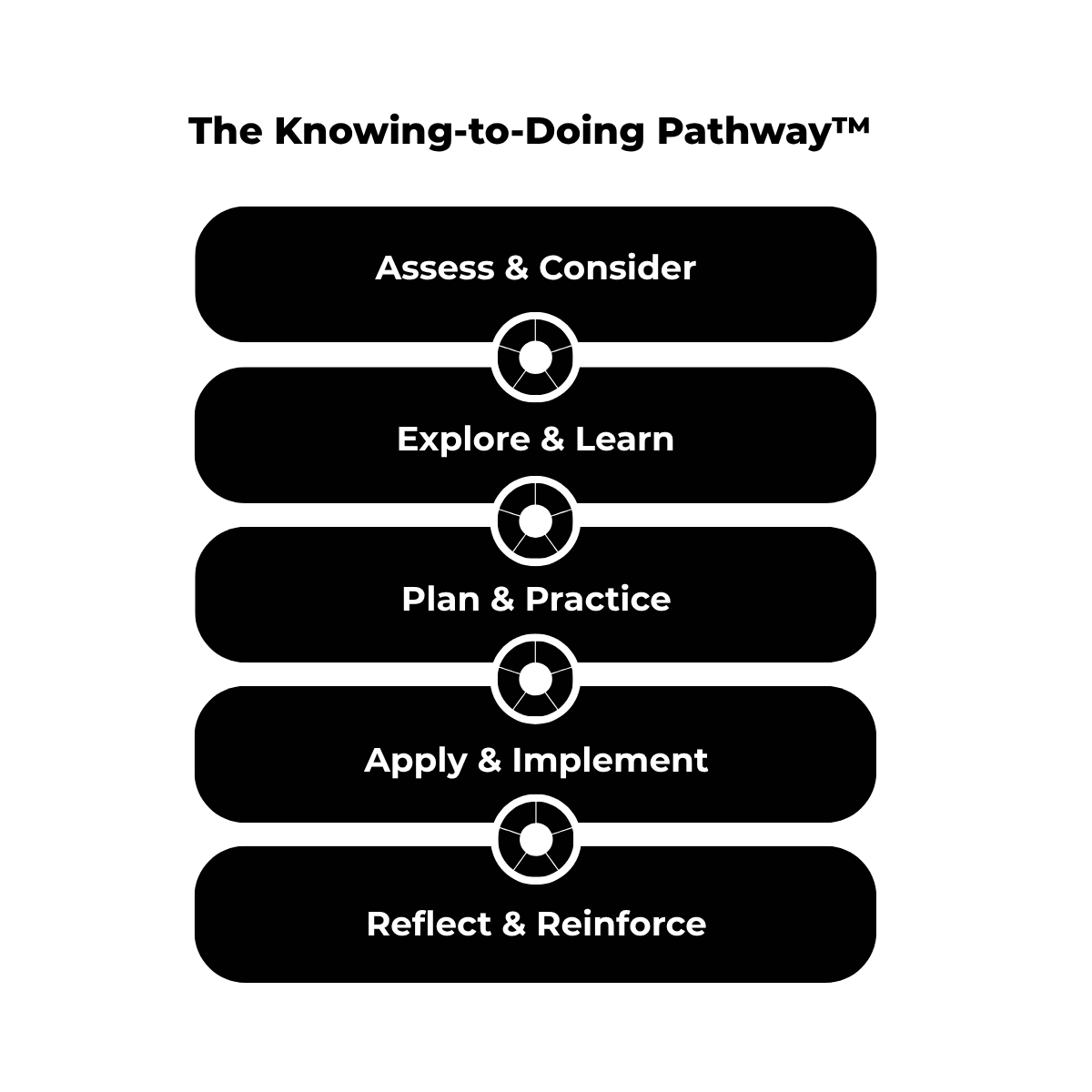
The Knowing-to-Doing Pathway™ organises that journey into five steps. Together, these steps provide a practical way to intentionally design leadership programs around the way behaviour change is most likely to occur:
-
Build awareness of current leadership behaviour and motivation for change.
-
Introduce new knowledge, skills and leadership perspectives.
-
Prepare, experiment with, and rehearse new behaviours.
-
Support leaders to apply new behaviours in everyday work.
-
Strengthen behaviour through feedback, reflection and ongoing reinforcement.
Every leadership program should achieve two outcomes.
The first is to develop better leaders by intentionally designing the participant journey around the way behaviour change is most likely to occur.
The second is to strengthen the organisation's capacity to develop leaders by intentionally designing the organisational conditions that help new leadership behaviours take hold and endure.
The strongest leadership programs don't choose between these outcomes.
They achieve both.
Designing for both from the start.
Designing for both outcomes means looking at the participant journey and the organisation surrounding it at the same time.
The Knowing-to-Doing Pathway™ helps design the participant journey around the way behaviour change is most likely to occur.
The LDS Wheel™ helps design the organisational conditions that enable new leadership behaviours to take hold and endure.
One designs the change. The other designs the conditions that allow that change to last.
Together, they inform how I design, build, deliver and strengthen leadership programs.
From challenge or opportunity to lasting change.
Every organisation starts somewhere different. Some are designing a new leadership program from the ground up. Others are refreshing an existing program that is no longer creating the impact they need.
Wherever we start, I work collaboratively with clients through five stages.
-
Key question
What leadership challenge are we really trying to solve?
Together we:
Review what's already in place and work with sponsors and key stakeholders to clarify the leadership behaviours that matter most, the organisational context and what success will look like.
Outcome
A shared understanding of the leadership challenge or opportunity and the outcomes the program needs to achieve.
-
Key question
What will help those leadership behaviours emerge and endure?
Together we:
Use the Knowing-to-Doing Pathway™ and the LDS Wheel™ to design both the participant journey and the organisational conditions that will support lasting behaviour change.
Outcome
A leadership development blueprint that shows how the program will work before we begin building it, including:
Program on a Page: A visual overview of the proposed approach and how the various elements work together.
Participant Journey: A high-level view of how leaders will engage with the program over time, including learning, application and reinforcement touchpoints.
Design Roadmaps: Each element of the program is outlined in sufficient detail to guide its full development.
Stakeholder Strategy: The role sponsors, line managers, peers and participants will play in supporting success.
Implementation Recommendations: Practical considerations for bringing the program to life.
Success Measures: How progress, behaviour change and organisational impact will be evaluated.
-
Key question
What do we need to bring the design to life?
Together we:
Turn the agreed design into the experiences, resources and supporting mechanisms the program requires - from diagnostics, workshops and participant resources to manager support, reinforcement and evaluation.
Outcome
A fully developed program ready to deliver.
-
Key question
How do we bring the program to life in a way that creates meaningful learning and change?
Together we:
Facilitate engaging, evidence-informed development experiences that help leaders explore, practise and apply new ways of leading, while creating opportunities to connect learning with the reality of their everyday work.
Outcome
A high-quality custom program that builds capability and creates momentum for change back at work.
-
How can we make this investment more valuable over time?
Together we:
Review participant feedback, behaviour change and organisational outcomes to understand what's working, what needs to change and what we're learning about the conditions that support leadership development in your organisation.
Outcome:
A program that continues to improve - and an organisation that gets better at developing leaders.
Every leadership program should leave something behind.
Leadership programs should do more than change the leaders who participate in them. They should strengthen the organisation that surrounds them.
As your custom program is designed, built, and delivered, leadership expectations become clearer. Sponsors become more engaged. Line managers become more confident supporting development on the job. Shared leadership language emerges. Better approaches to reinforcement and evaluation are established.
The program develops better leaders, but it also leaves the organisation better able to continue developing them.
That's how each investment can create value beyond the program itself.
When leadership development develops better leaders and strengthens the organisation's capacity to develop them, its value doesn't end when the program does; it compounds.
The organisational capacity built through one investment becomes part of the environment surrounding the next.
Over time, that growing capacity becomes an organisational capability.
The organisation gets better at developing leaders.
Let’s work out what will create the greatest impact
If you're designing a new leadership program, refreshing an existing one or simply exploring where to invest next, I'd love to hear what you're trying to achieve.
Together, we'll work out what will create the greatest impact for your leaders and your organisation.