
About Justine La Roche
BA(Psych)(Hons) MPsych(Org) MAPP
Registered Psychologist

I’ve spent my career trying to understand what makes leadership development work.
For more than 20 years, I've partnered with organisations to design leadership strategies, frameworks, and programs.
Across different industries, organisational contexts and leadership levels, I've had the opportunity to see leadership development from many angles.
Some programs created lasting change. Others generated plenty of enthusiasm but shifted little once people returned to work.
Like many practitioners, I initially looked to the quality of the program for the answer: the content, the facilitation, the participant experience.
Those things matter. But over time, I realised the difference wasn't always in the program.
It was often in the organisation surrounding it.
Leadership development doesn’t occur in a vacuum.
It happens within an organisation that is constantly shaping leadership behaviour.
Through the expectations leaders are held to. The opportunities they have to practise. The conversations they have with their line managers. The feedback they receive. The behaviours that are rewarded. And the processes and practices that either reinforce new ways of leading or quietly pull people back towards old habits.
The more I observed this, the more I kept coming back to the same idea.
Leadership development creates its greatest value when it becomes something an organisation does, not simply something it buys.
A broader ambition for leadership development.
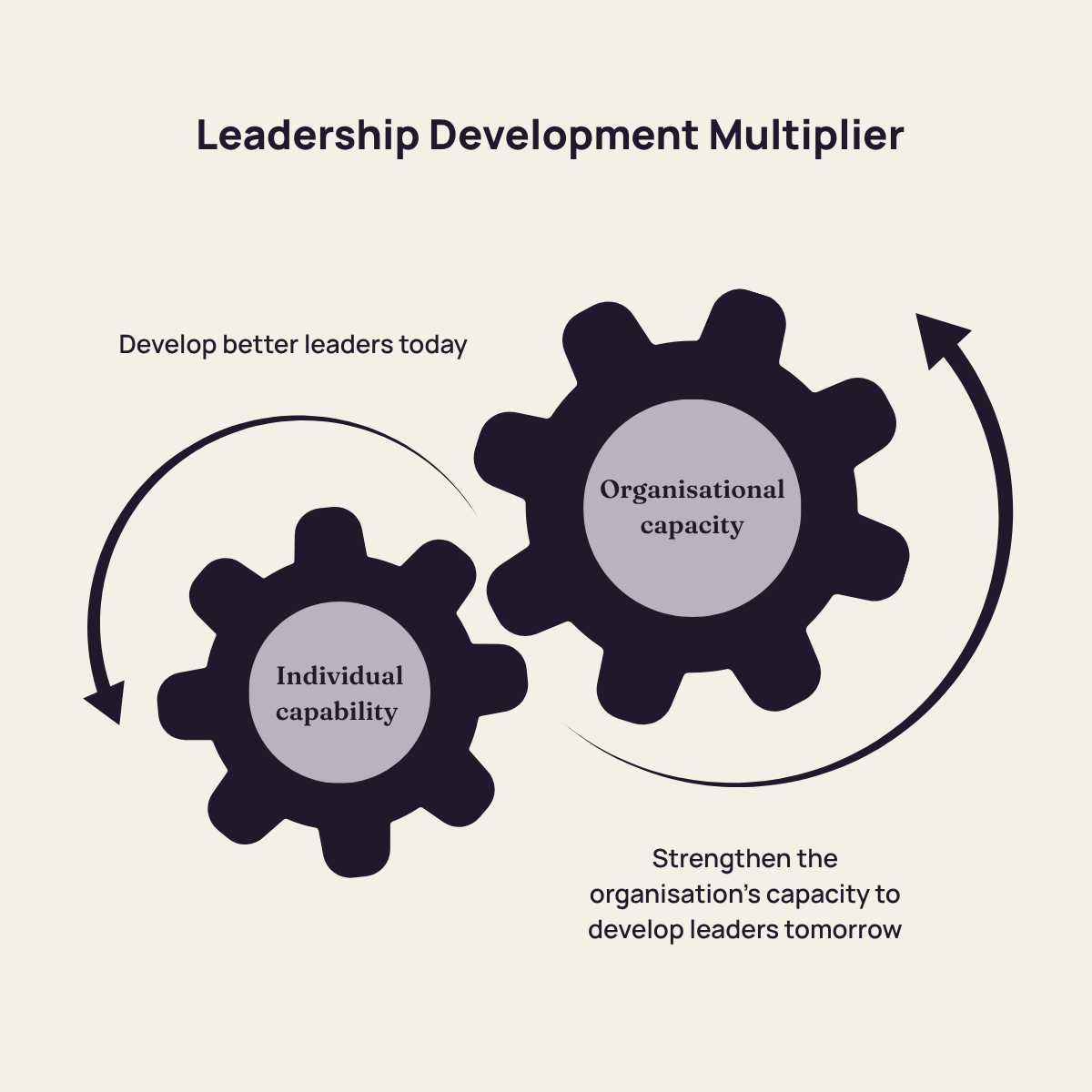
Today, I believe every investment in leadership development should achieve two things: develop better leaders today and strengthen the organisation's capacity to develop leaders tomorrow.
Many organisations invest successfully in the first. Fewer deliberately invest in the second.
Yet it's the interaction between the two that creates the greatest long-term value.
When each investment grows organisational capacity, the next initiative starts from a stronger foundation. Over time, that greater capacity becomes an organisational capability.
Leadership development stops being a series of disconnected initiatives and becomes something the organisation gets better at doing.
That’s the work I love.
From observation to methodology.
My observations and experiences have evolved into two interconnected organising principles that now guide my work.
They bring together what I've learned about behaviour change, leadership development and organisational systems to help organisations develop better leaders and become better at developing them.
-
The Knowing-to-Doing Pathway™ grew from my interest in what it actually takes to move from knowing how to do something to actually doing it. It helps design the participant journey around the way behaviour change is most likely to occur.
-
The LDS Wheel™ grew from recognising that behaviour change doesn't happen in isolation. It helps organisations understand and intentionally strengthen the conditions that allow new leadership behaviours to take hold and endure.
One designs for behaviour change. The other designs the conditions that allow that behaviour change to last.
Together, they inform how I help organisations design, build and deliver leadership programs, and understand and strengthen the leadership development systems that surround them.
Different challenges require different starting points, but the ambition remains the same: to help organisations get more from leadership development.
I believe the best leadership development solutions are co-designed, not prescribed.
That means thoughtful conversations, healthy challenge and close collaboration with the people who know the organisation best.
I bring research, experience, and seasoned judgement. My clients bring their expertise, organisational knowledge and understanding of what will and won't work in their context.
The best solutions emerge when we put those things together.
Sometimes that means designing and delivering a custom leadership program. Other times, it's about understanding and strengthening the leadership development system around your leaders. Or it might be helping an HR, OD or L&D leader work through an important decision.
Whatever the engagement, my role is the same: to broaden how organisations think about leadership development so they can make better decisions and act on them with confidence.
My background.
I'm a registered psychologist with Masters qualifications in Organisational Psychology and Applied Positive Psychology, and more than 20 years' experience in leadership development and organisational development.
My career has taken me from assessing individual leadership potential and team effectiveness to designing leadership strategies, developing organisational capability frameworks and leading the design and implementation of leadership development solutions at scale.
I've worked both inside large organisations and as an external consultant, across a wide range of industries and organisational contexts.
That combination has given me an appreciation of leadership development from different perspectives: the individual leader trying to do things differently, the HR or L&D team designing and delivering development, and the organisation whose everyday practices can either support or undermine that effort.
My psychology background means I care deeply about evidence. Years of working with organisations have taught me to care just as much about whether an idea works in practice.
I enjoy making complicated things simpler, exploring ideas with people and translating research into practical approaches that make sense for the organisation in front of me, not someone else's.
It is this combination of research, experience and practical application that continues to shape how I help organisations get more from leadership development.
Let’s work out what will create the greatest impact.
Whether you're designing a leadership program, strengthening how your organisation develops leaders, or simply deciding where to invest next, I'd love to hear what you're trying to achieve.
Together, we'll determine what will create the greatest impact for your leaders and organisation.