The LDS Wheel™
An organising principle for understanding, designing and strengthening leadership development systems.
For decades, leadership development has focused primarily on changing leaders.
Organisations invest in programs, coaching, assessments and other development experiences because they want leaders to think differently, behave differently and create better outcomes.
Many of these investments add value.
They build insight, capability and confidence, and give leaders the opportunity to step away from the pressures of their everyday lives to think more deliberately about how they lead.
Yet even when a development experience creates genuine change, another challenge remains.
What happens when leaders return to work?
They go back to the same meetings, expectations, priorities, and performance pressures. They’re met with managers who may or may not reinforce what they have learned, people practices that may send conflicting signals, and organisational norms that quietly teach them what leadership really looks like around here.
Sometimes organisational conditions help new leadership behaviours take hold.
Other times they pull leaders back into their old ways of working.
Organisations shape leadership behaviour more powerfully than programs alone.
This simple observation has shaped the way I think about leadership development.
It sits at the heart of the Leadership Development System (LDS) Wheel™.
Programs matter. They just can’t carry the whole load.
Leadership programs remain one of the most important investments an organisation can make. They're also one of the most practical.
A program can be clearly scoped, budgeted, purchased, communicated and scheduled. It has a beginning, an end and a defined group of participants. Providers can package their expertise into a recognisable offer, while organisations can point to something tangible and say, "This is how we are developing our leaders."
There is nothing inherently wrong with this. In fact, it helps explain why programs have become the dominant form of leadership development.
As David Day and Laura Dannhäuser (2024) observe, programs are well suited to being packaged, marketed and sold as discrete products while fitting neatly within organisational budgets and administrative processes. Their concern is not that programs have no value, but that their bounded, episodic nature does not align with the ongoing nature of leadership development itself.
Leadership programs make sense, but there’s more to it.
Behaviour is shaped every day by the organisations that leaders are part of - through the expectations they are held to, the opportunities they are given, the conversations they have with their managers, the feedback they receive, and the behaviours that are rewarded, tolerated and talked about.
Together, these influences form a system.
One that can reinforce development or quietly work against it.
This changes the ambition for leadership development.
Leadership development should be intentionally designed not only to develop better leaders, but also to strengthen the organisation's capacity to develop them.
Because capability isn't purchased.
It's built.
From buying leadership development to building the capacity to develop leaders.
It's easy to confuse having leadership development activities with having a leadership development system.
An organisation may have a leadership framework, a suite of assessments, several programs, executive coaching, talent reviews and succession planning.
Each may be valuable, but collectively, they may still feel fragmented.
Different initiatives may use different leadership models, target different populations and reinforce different expectations. They may have been introduced at different times, for different reasons and by different sponsors.
A leadership development system is different. Its parts are connected. They influence one another and work together in service of a larger purpose.
And with it, the ambition changes accordingly.
The goal is no longer simply to provide leadership development.
It is to become an organisation that gets better at developing leaders.
When practice meets research.
Over more than 25 years of designing and implementing leadership development across different industries, organisations, and leadership levels, I became increasingly interested in a simple question.
Why did some leadership development create lasting change, while other initiatives lost momentum once participants returned to work?
Initially, I looked for the answer in the quality of the program itself.
Over time, my attention shifted to the organisation surrounding it.
Was there clarity about what good leadership looked like?
Were senior leaders actively shaping and reinforcing the development?
Did line managers know how to support participants?
Was leadership development embedded into everyday work?
Did each initiative build on what had come before and strengthen what came next?
Gradually, I realised I wasn't simply designing leadership programs.
I was making decisions, often implicitly, about the leadership development system those programs sat within.
Around the same time, the research began pointing in a remarkably similar direction.
Day and Dannhäuser (2024) argued that leadership development is continuous, adaptive and shaped through ongoing interaction with the organisational environment rather than occurring primarily within programs.
Anna Fabisch and her colleagues' (2024) 30-year longitudinal study traced how one organisation's approach to leadership development evolved from being centred primarily on programs towards one integrated into regular meetings, day-to-day routines and the broader business system. Leadership development became embedded in the way the organisation operated, rather than remaining something that sat alongside it.
Similarly, Gunilla Avby and her colleagues (2025) found that leadership development was more effective when closely connected to an organisation's strategy, values, history and identity, rather than operating as a separate set of initiatives.
Together, these findings arrive at a broadly similar conclusion: Leadership development creates greater value when it is understood as a deliberately designed system, not as a collection of one-off initiatives,
That was the point at which research and practice converged for me.
What is a leadership development system?
A leadership development system (LDS) is the sum of an organisation's deliberate choices about how leadership is developed in service of its purpose, values and strategy.
It includes the programs, coaching, assessments and development resources people often associate with leadership development.
But it extends well beyond them.
It also includes the expectations leaders are held to, the experiences through which leadership is developed, the people practices that reinforce it, the role managers and sponsors play, and the ways leadership development is reviewed and strengthened over time.
Some parts of the system are highly visible.
Others are embedded in the way the organisation already works.
Together, they create the organisational conditions that shape leadership behaviour every day.
The LDS Wheel™
The Leadership Development System (LDS) Wheel™ is an organising principle for understanding, designing and strengthening leadership development systems.
Its purpose is to help organisations intentionally design the organisational conditions that make leadership behaviour more likely to take hold and endure.
Rather than treating leadership development as a collection of disparate activities, the LDS Wheel™ helps organisations think more deliberately about the qualities of a healthy leadership development system and the relationships between them. Its value lies not only in each individual dimension, but in the way those dimensions interact.
Some reinforce one another.
Coherence and Continuity, for example, help create a recognisable leadership philosophy over time.
Others create productive tensions.
Adaptability encourages leadership development to evolve as organisational needs change, while Continuity helps prevent every change in strategy or leadership from becoming a complete reinvention of the organisation's approach.
The goal isn't to maximise every dimension independently. It’s to understand how they work together.
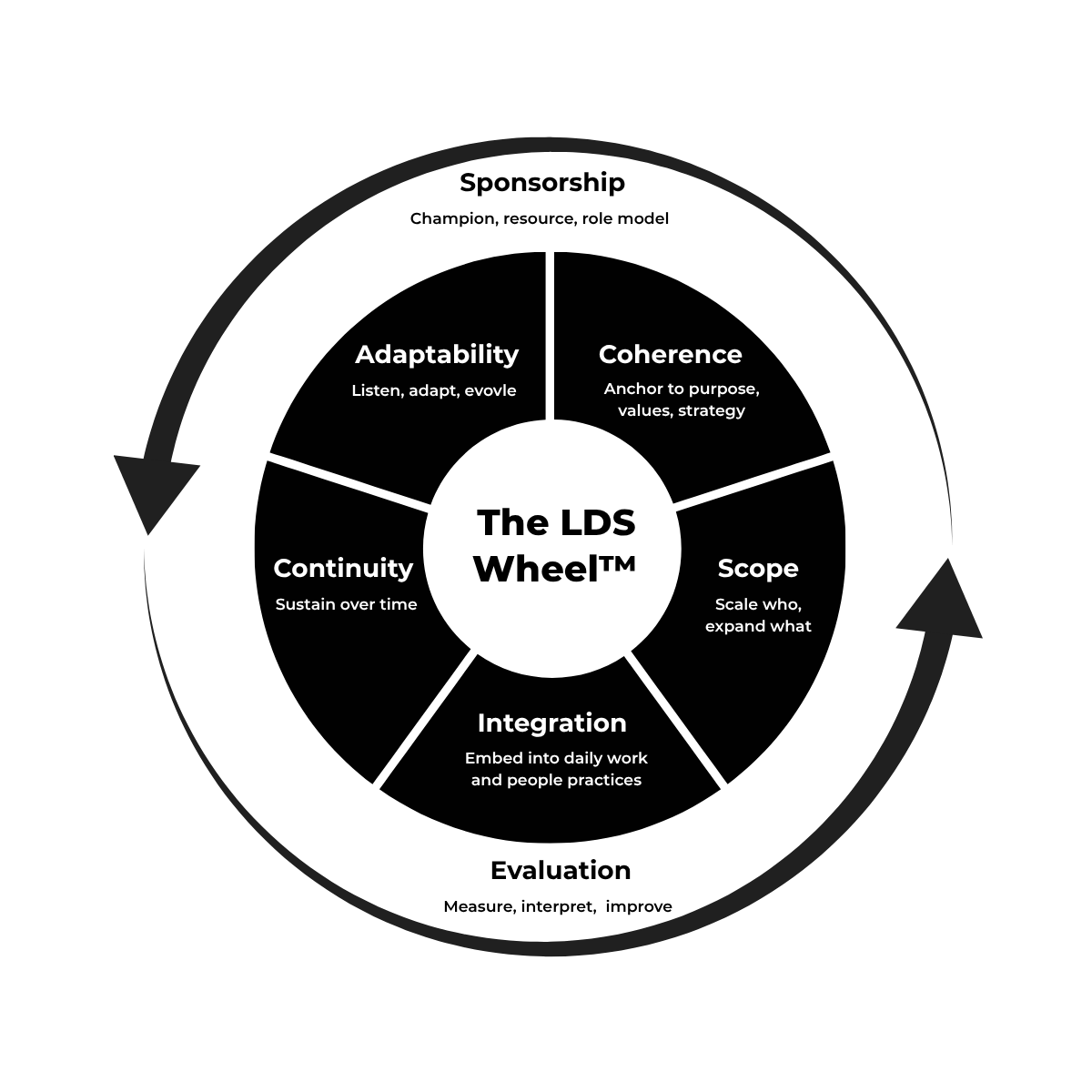
Adaptability
Adaptability is the capacity of a leadership development system to learn and evolve as the organisation and its environment change.
Leadership priorities are rarely static. A shift in strategy may require different leadership behaviours. Growth may demand new ways of working across teams. Changes in regulation, technology or customer expectations can expose leadership challenges that weren't visible when the system was first designed.
An adaptable system notices these shifts. It uses feedback, evaluation, organisational data and anecdotal evidence to refine leadership priorities, development approaches and supporting practices over time.
This doesn't mean redesigning everything whenever circumstances change.
A system that continually reinvents itself may be responsive, but it is unlikely to build capability.
Adaptability therefore works in productive tension with Continuity.
The aim isn't constant change. It's thoughtful evolution.
The design question becomes:
How will your leadership development system continue evolving as your organisation changes?
In practice, this might mean reviewing leadership priorities alongside strategic planning, using evaluation findings to refine existing initiatives, or adapting development approaches as new organisational needs emerge.
Adaptability keeps the system relevant without losing what makes it recognisable.
Coherence
Coherence is the degree to which leadership development reflects and reinforces what the organisation is trying to achieve and become.
Every leadership development investment sends signals about what leadership matters.
When programs, talent processes, performance expectations and everyday leadership conversations tell the same story, leaders experience greater clarity about what good leadership looks like.
When they don't, leadership development becomes fragmented.
A program may encourage empowerment while decision-making remains highly centralised.
A leadership framework may emphasise collaboration while reward systems continue to favour individual performance.
Different providers may introduce competing language and models, leaving leaders to reconcile multiple versions of what “good” actually looks like.
Coherence doesn't require every initiative to look the same, but it does require a recognisable throughline.
The design question becomes:
How will leadership development reinforce the organisation you're trying to build?
In practice, this might involve clarifying a small number of leadership expectations linked to strategy, aligning development and people practices to those expectations, and ensuring leaders encounter consistent language across recruitment, performance, talent and development conversations.
Leadership development becomes part of how the organisation builds its culture, not simply how it develops individuals.
Scope
Scope considers how comprehensively leadership is developed across the organisation, including who is developed, where development happens and how leadership capability is built.
A narrow system often concentrates on formal programs for selected leadership groups.
A broader system recognises that leadership develops across levels, through many different experiences and in many different places. This includes formal learning, coaching, mentoring, peer learning, stretch assignments, project work and the everyday challenges of leading.
Scope isn't about providing everything to everyone.
It's about ensuring leadership development reaches everyone, and everywhere it needs to be.
The design question becomes:
How broad is our approach to leadership development - in who we develop, where development happens and how leadership capability is built?
In practice, organisations may connect formal leadership programs with mentoring, on-the-job projects, peer learning and manager coaching. They may create development pathways for people before they enter formal management roles, while also supporting experienced leaders to continue growing.
Leadership development becomes something experienced across the organisation rather than something attended by a few.
Integration
Integration is the degree to which leadership development becomes embedded in everyday work and organisational practices.
Leadership development often sits alongside the organisation. An integrated system makes it part of the organisation.
Leadership develops through team meetings, project reviews, performance conversations, customer work, strategic planning, and everyday interactions where leadership is continually exercised.
It also becomes woven into the organisation's people practices.
Recruitment signals what leadership matters.
Onboarding begins shaping expectations.
Performance and talent processes reinforce them.
Succession decisions reveal which behaviours the organisation genuinely values.
The design question becomes:
How will leadership development become part of the way work gets done?
In practice, this might involve equipping line managers to coach through regular one-to-ones, building reflection into existing team rhythms, using real organisational challenges as development experiences, or aligning people practices with the leadership behaviours the organisation wants to strengthen.
Development becomes part of leading rather than something separate from it.
Continuity
Continuity provides the throughline that allows leadership development to build meaning and momentum over time.
Many organisations don't stop investing in leadership development. They repeatedly start again.
A new executive introduces a preferred leadership model.
A new provider brings different language.
A new trend reshapes the programs on offer.
Each initiative may be worthwhile, but collectively, frequent changes in direction make it difficult for leadership capability to accumulate.
Continuity doesn't mean preserving programs indefinitely or resisting new ideas.
It means maintaining a recognisable philosophy while allowing the system to evolve.
The design question becomes:
How will leadership development maintain a clear throughline while continuing to evolve?
In practice, this might involve retaining consistent leadership expectations while refreshing how they are developed, connecting each initiative to previous investments, and ensuring changes in sponsorship don't automatically trigger a complete reset.
Continuity allows leadership capability to build rather than continually starting again.
Sponsorship
Sponsorship is the active role senior leaders play in shaping, enabling and reinforcing leadership development.
I believe it’s often interpreted too narrowly - a sponsor approves the budget, opens the program, appears in a video, receives an evaluation report.
Those contributions can certainly help, but sponsorship can be much more than that.
Sponsors help define why leadership development matters and what it needs to achieve. They contribute to its design, create permission for leaders to invest time in development, remove barriers to application, advocate for the work and consistently model the leadership behaviours the organisation is trying to develop.
Their involvement signals that leadership development isn't simply an HR initiative operating at the edge of the business. It’s part of how the organisation delivers its strategy.
The design question becomes:
How will senior leaders actively shape, enable and reinforce leadership development?
In practice, this might include involving sponsors in co-design, clarifying the role they'll play throughout an initiative, asking them to reinforce leadership expectations in business forums, or creating opportunities for them to model the behaviours the organisation is seeking to strengthen.
Sponsorship isn't a launch activity. It’s an ongoing leadership responsibility.
Evaluation
Evaluation is how a leadership development system learns and improves over time.
Most organisations evaluate individual programs. They measure attendance, satisfaction, confidence and, increasingly, changes in behaviour or performance. Those measures matter, yet a systems perspective asks a broader question:Is the organisation becoming better at developing leaders?
That changes what evaluation is for.
Rather than simply judging the success of a single initiative, evaluation helps organisations understand how well the overall leadership development system is working. It highlights where different parts of the system reinforce one another, where they create friction, and where the next improvement is most likely to strengthen the whole.
No single measure provides that answer. It emerges by bringing together different forms of evidence such as program data, leadership assessments, qualitative feedback, sponsor observations, patterns across talent and succession, engagement results and business outcomes, and uses them to inform future design decisions.
The design question becomes:
How will we know whether our leadership development system is becoming stronger over time?
In practice, this might involve defining success at both program and system levels, periodically reviewing the organisation's leadership development system against the dimensions of the LDS Wheel™, and using those insights to shape future investment rather than simply report on past activity.
Evaluation doesn’t simply measure leadership development. It helps improve it.
Designing the system with the program
The LDS Wheel™ can be used to review an organisation's overall approach to leadership development. It can also shape the design of an individual leadership initiative. This is where the distinction between a program delivered to an organisation and one designed with it becomes important.
An off-the-shelf program can provide an excellent learning experience. It may contain outstanding content, skilled facilitation and well-tested tools. Its strength lies in the quality of the program itself.
A custom-designed program creates a different opportunity.
From the moment sponsors, internal practitioners and business leaders begin defining the leadership challenge together, the organisation starts strengthening its own capacity to develop leaders.
Leadership expectations become clearer.
Sponsors become more engaged.
Line managers become more involved.
Shared language begins to emerge.
New approaches to reinforcement, coaching and evaluation are established.
The program still develops participants. It also leaves the organisation better able to continue developing leaders long after the program has finished.
That's the opportunity. Leadership development should be intentionally designed not only to develop better leaders, but also to strengthen the organisation's capacity to develop them.
The strongest leadership programs do both.
Every leadership development investment therefore has the opportunity to leave something behind. Sometimes that is a group of leaders who have developed new knowledge and skills. Or it can also strengthen the overall leadership development system.
Sponsors become better equipped to champion leadership development.
Managers become more confident supporting development in everyday work.
Leadership expectations become clearer and more consistent.
Evaluation becomes more meaningful.
Future initiatives begin from a stronger foundation than the last.
Each investment strengthens organisational capacity. Repeated over time, that growing capacity becomes an organisational capability to the point where leadership development becomes something the organisation does, not simply something it buys.
Designing differently
The Leadership Development System (LDS) Wheel™ doesn't diminish the importance of leadership programs.
It broadens their ambition.
The starting question is no longer simply:
What leadership program do we need?
It becomes:
How can this investment develop better leaders while also strengthening our organisation's capacity to develop them?
That question has changed almost every leadership development decision I make.
Because organisations shape leadership behaviour more powerfully than programs alone.
The Leadership Development System (LDS) Wheel™ is simply the organising principle I've found most useful for understanding, designing and strengthening that influence.
References
Avby, G., Ellström, P.-E., & Forslin, J. (2025). Leadership development systems: Towards a systems perspective on leadership development. Human Resource Development Review.
Day, D. V., & Dannhäuser, L. (2024). Reimagining leadership development: From programs to systems. Leadership Quarterly.
Fabisch, A., Gruber, M., & colleagues. (2024). Leadership development systems: A longitudinal study of organisational evolution. Human Resource Development Quarterly.