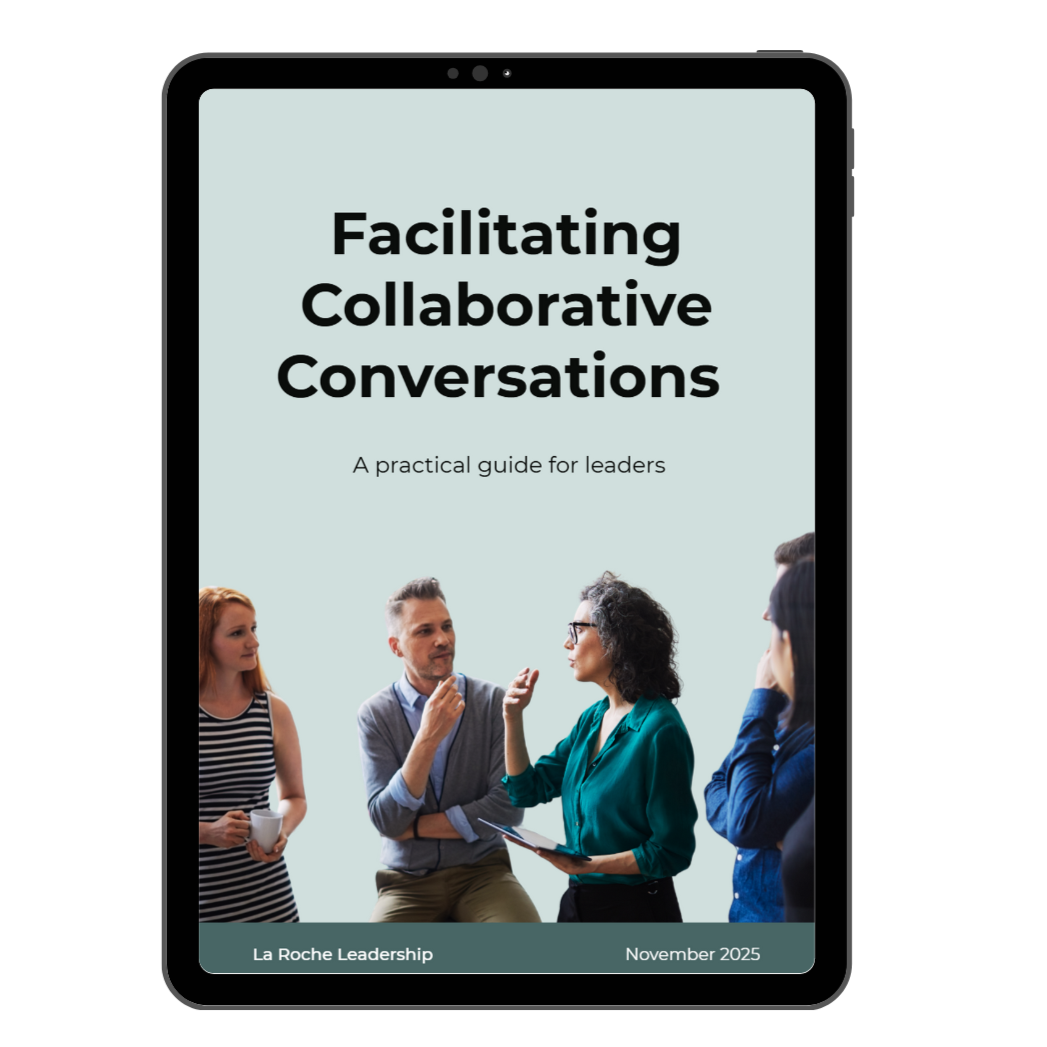
Help your leaders become facilitators within and across teams
The ability to facilitate conversations within and across teams is a core leadership capability - and a strategic lever for trust, collaboration, and performance.
This is because the best decisions are rarely made in isolation. They emerge from conversations that surface diverse perspectives, constructively explore disagreement, and turn shared insight into action.
Why a dual focus is necessary
In almost every leadership program I’ve delivered this year, one consistent theme has emerged: leaders are being asked to operate in dual modes - both within and across teams.
Within teams: How do I engage, develop, and lead my people day-to-day?
Across teams: How do I collaborate with peers, influence stakeholders, and contribute to broader outcomes?
Many leadership programs are geared toward the first. But it’s the second - the across teams focus - where things can really break down.
Too often, challenges that could be resolved peer-to-peer are escalated up the chain. Questions, concerns, or feedback are sat on, rather than shared. Or ideas that could have sparked progress are quietly dropped because leaders don’t have the tools or confidence to facilitate disagreement well.
Supporting leaders in building the skills to have more collaborative conversations is critical in enabling them to drive progress without hierarchy, build trust across teams, and implement change.
Why conversations are the ideal anchor for capability-building
Conversations offer something that most leadership tools don’t: daily opportunity for practice.
They happen in meetings, one-on-ones, hallway catch-ups, and project check-ins. They’re where strategy becomes reality, where relationships are strengthened or strained, and where collaboration either moves forward or gets stuck.
In other words, conversations are where leadership shows up - or doesn’t.
Conversations are naturally recurring, immediate, and observable, making them ideal anchors for behaviour change.
Leaders as facilitators
Facilitating collaborative conversations means paying attention to three key steps:
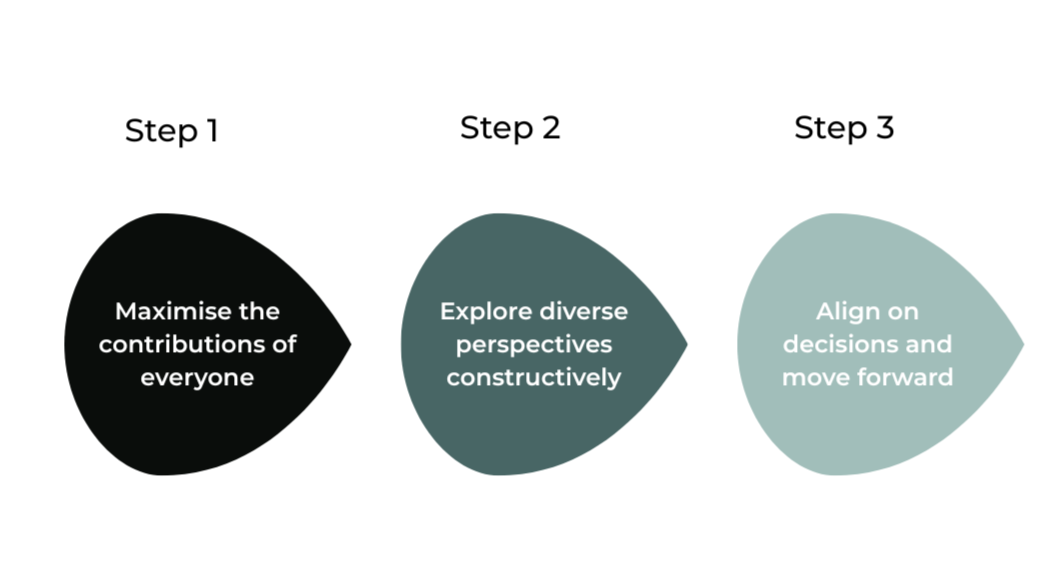
Step 1: Maximise the contributions of everyone
This step is about creating the space, structure and safety that allow people to contribute fully. It’s about ensuring that all voices, not just the fastest, loudest, or most dominant, are heard.
Key techniques:
No Bad Ideas zone: reduces fear of judgment and unlocks creativity, especially in early-stage discussions.
Think–Pair–Share: encourages equal participation through private reflection and paired discussion before sharing in the group.
Build & Bounce rounds: balances idea-building with respectful challenge to avoid groupthink.
Step 2: Explore diverse perspectives constructively
This step is about managing group dynamics and validating differences as a source of better thinking. It involves staying curious, even under pressure, and engaging productively, not simply being polite, especially across teams and functions with different priorities.
Key techniques:
Permission to Disagree: a prompt to explicitly invite different views and reduce politeness pressure.
“Yes, and…” instead of “Yes, but…”: a simple language shift that keeps dialogue open and lowers defensiveness.
Step 3: Align on decisions and move forward
This step is about integrating ideas into a shared direction that people are ready to support. It’s where leaders convert a conversation into a commitment.
They do this by clarifying outcomes, driving accountability with visible next steps, and revisiting decisions at specified review points as needed.
Key techniques:
Laddering or scaling: helps surface nuanced levels of support or concern during decision-making.
Consent or commitment checks: where people actively signal their support, even if the direction isn’t their first choice.
Provide your leaders with immediate support
While these three steps may seem logical, they’re not always easy. That’s why I created the Facilitating Collaborative Conversations guide, a clear, step-by-step toolkit to support leaders in facilitating more effective conversations within and across teams.
You can use it to:
Build leaders' facilitation skills (the guide is particularly geared toward team leaders and middle managers) or anyone else who convenes or participates in conversations where perspectives differ and outcomes matter.
Encourage more courageous, cross-functional dialogue.
Reduce reliance on escalation as the default solution.
Reinforce daily conversation habits that facilitate collaboration and create cultural change over time.
Download the free guide here or reach out if you’d like to explore how to embed these collaborative conversation practices more deeply across your organisation.